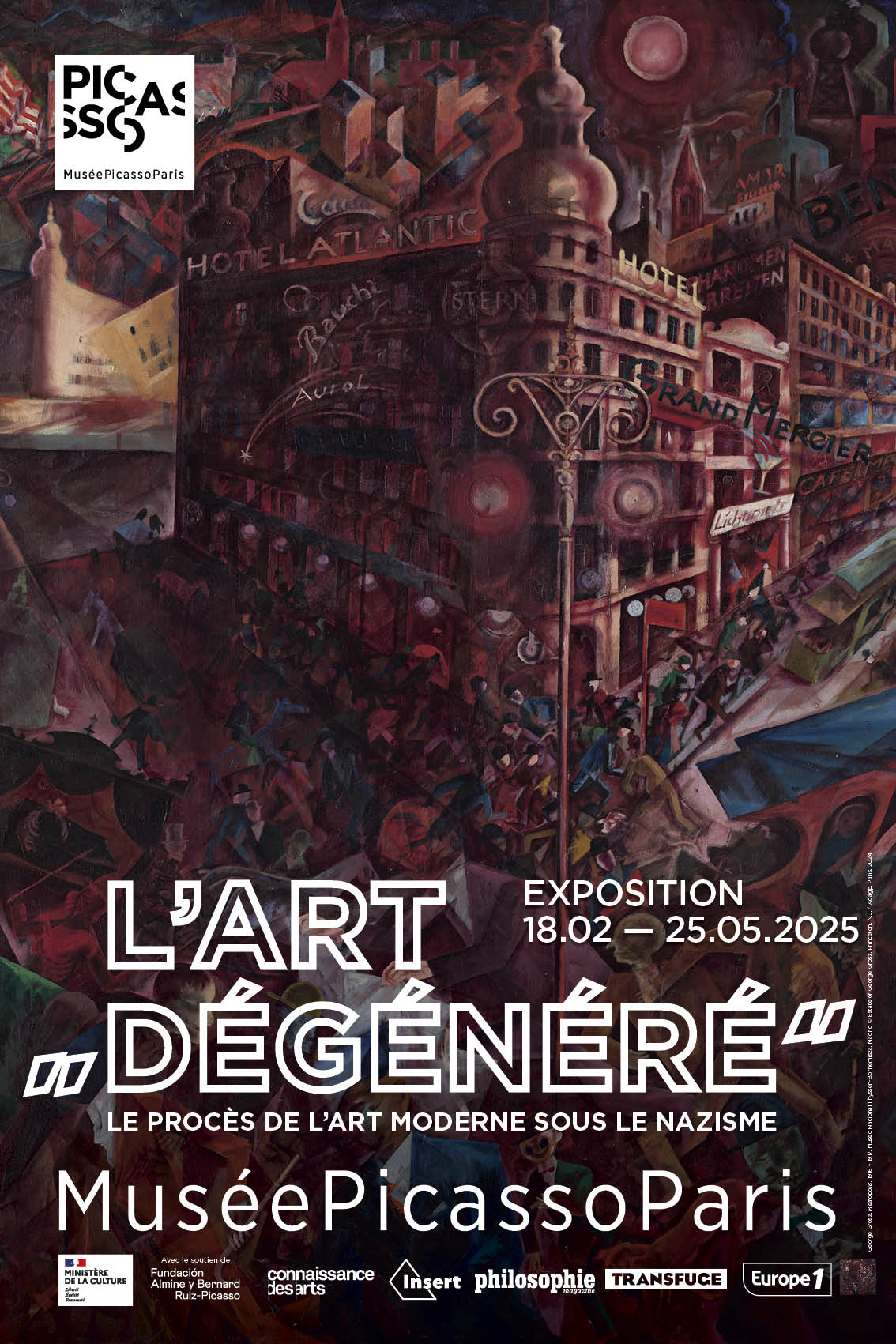
Thumbnail: poster for the exhibition L’art « dégénéré » : Le procès de l’art moderne sous le nazisme at the Musée national Picasso-Paris [18th of February 2025 – 25th of May 2025]. Source: https://www.museepicassoparis.fr/fr/agenda/lart-degenere-le-proces-de-lart-moderne-sous-le-nazisme/
“As in any totalitarian regime that claims to define a « New Man, » art was a priority for the apostles of National Socialism, and the Nazis’ obsession was to make art into an instrument of propaganda.” (Anne Sinclair, 21 rue La Boétie, p. 44. Own translation)
The term “Degenerate art”, or “Entartete Kunst” in german, was used by the nazi regime between 1933 and 1945 to refer to art that was deemed corrupted, un-German, and against traditional values proned by the regime. It mainly targeted modern and abstract art. Artists were persecuted. The goal was to condemn this “perverted” art and to promote in its place a “pure” art that would better reflect the German people. In 1937, the exposition Entartete Kunst was held in Munich so that German people could come see and mock this “unclean” art. In only four months, the exposition received over 2 million visitors. (Johan Popelard)
The exposition Art Dégénéré, held by the Picasso museum, brings together over 700 works of these so-called degenerate artists, and draws a point on the research we have so far on the Entartete Kunst exposition, and the persecution of modern artists during the nazi regime.
Max Pechstein, Nature morte: statuette des mers du Sud et des fleurs, 1917, Oil on canvas, Kunsthalle, Mannheim

I particularly liked this work by Max Pechstein. I think the colors all fit together so well, the light blue background complimenting the beautiful purple shades of the flowers and the deep brown of the statue. I also really like the brush work, with big, apparent strokes and a background that is not completely uniform. Everything is treated with square and angular shapes, which make the composition interesting to look at.
Wilhelm Morgner, Homme bleu dans un paysage jaune, s. d. Distemper on cardboard, LWL – Westfälisches Landesmuseum für Kunst und Kulturgeschichte, Münster

This distemper reminds me of works by Van Gogh, using a similar color scheme, similar subject matter and similar brush work. Distemper is not a medium I am used to seeing, so this was interesting to me. I like how, in contrast to Pechstein’s work, all of the shapes are round: the trees, the man’s hat, the movement of the sky. I am especially fond of the trees, with their wavy trunks and round tops made of different shades of green.
Ernst Ludwig Kirchner, Rue à Berlin, 1913, Oil on canvas, MoMA, New York

This work drew me in with its bright, saturated colors. Kirchner is a painter I studied a lot during my class on 20th century art. Originally a member of the german expressionist group Die Brücke, Kirchner’s twenties in Dresden were shaped by long and tranquil afternoons by the water with his fellow painters. Upon his arrival in Berlin in 1911, Kirchner faces disillusionment : the city night life, with men in top hats and prostitutes, feels oppressive to him.
Kirchner often represented this harsh Berlin night life in expressionist paintings such as this one. The
characters look fragmented, composed of long triangles and broken angles. This makes them look dangerous, and makes the paintings feel as if it’s slipping to the floor, translating the anxiousness Kirchner felt.
Bibliography:
SINCLAIR Anne, 21 rue La Boétie, Grasset, 2012, p. 44.
POPELARD Johan, “L’art dégénéré” : le procès de l’art moderne sous le nazisme : [exposition, Paris, Musée national Picasso, 18 février – 25 mai 2025], 2025, Paris, Musée Picasso, Grand Palais RMN Éditions
https://www.museepicassoparis.fr/fr/agenda/lart-degenere-le-proces-de-lart-moderne-sous-le-nazisme/
Laisser un commentaire