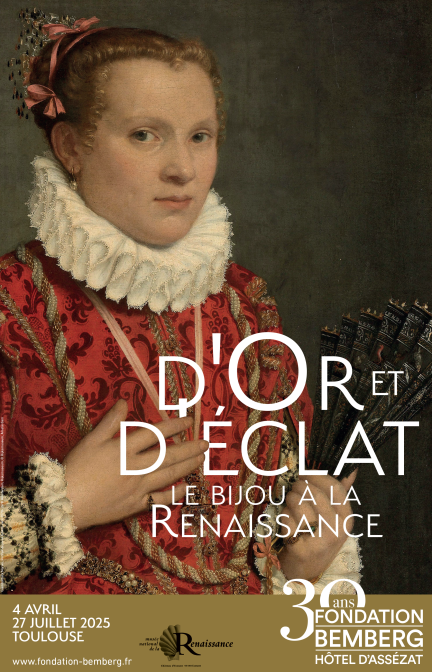
Thumbnail: poster for the exhibition D’or et d’éclat. Le bijou à la Renaissance at the Fondation Bemberg, in partnership with the musée national de la Renaissance – Château d’Écouen [4th of April 2025 – 27th of July 2025]. Source: https://infine-editions.fr/publications/dor-et-declat/
This exposition, organized at the Fondation Bemberg in Toulouse, in partnership with musée national de la Renaissance – Château d’Écouen, sums up what research we currently have on jewelry during the Renaissance, thanks to its gathering of extraordinary jewels, ceramics with jewels and paintings of jewels.
François Clouet, Portrait de Charles IX, vers 1570, Huile sur bois, Toulouse, Fondation Bemberg

Charles IX was one of France’s kings, son of François Ier. I studied this painting while preparing a presentation on Clouet’s Portrait équestre de François Ier for my course on 16th and 17th century art. Jean Clouet, and his son François Clouet, worked as artists for the king François Ier. They helped develop a new kind of royal propaganda by creating and sharing numerous portraits of the king. This effort continued after François Ier’s death, during the reign of his son Henri II on demand of his wife, Catherine de Medicis, and during the reign of his grandson Charles IX. This
painting shows us how the Clouets, thanks to their artistic talents, helped develop the art of the portrait in France, and gave the ruling kings a new kind of legitimacy.
Alonso Sánchez Coello, Portrait d’Anne d’Autriche, vers 1575-1580, Huile sur toile, Toulouse, Fondation Bemberg

Anne d’Autriche (1549-1580) was one of Spain’s queens : wife of Philippe II of Spain, and mother of Philippe III of Spain. I really like this painting because of the extraordinary attention to detail. We can see the slight blush of her cheeks, against the fairness of her skin and the shiny gray of her hair. Around her neck, she wears a collar adorned with spectacular lace, that can also be found around her wrists and on the handkerchief she carries. The deep black of her dress pulls the spectator in, contrasting with the slightly lighter background. The chair is also represented in incredible detail, with the dangling tassels and shiny metal parts. Most impressive is her shiny gold jewelry, decorated with pearls that reflect the light. In her hair, she wears a brooch with impressive gems, and a big dangling pearl.
Atelier de Bernard Palissy (Agenais vers 1510 – Paris 1590), Coupe, Paris, troisième quart du XVIe siècle, terre cuite glaçurée, Ecouen, Musée national de la Renaissance – château d’Ecouen

Bernard Palissy was a French potter from the 16th century, known for his dishes decorated with fish, frogs, and snakes. One of his goals was to create imitations of royal ceramics, made with costly materials, using cheaper alternatives. We can see this in this chalice : using glazed terracotta, Palissy imitates the whiteness of porcelain for the body of the cup and makes the added details resemble gold and precious stones. This chalice shows that creativity and ingenuity are not reserved for the Fine Arts. On the contrary, pottery and furniture can be valuable witnesses to the stylistic ambitions and technical constraints of a specific period.
Bibliography:
ROHOU Julie, D’or et d’éclat : le bijou à la Renaissance :[exposition, Toulouse, Fondation Bemberg, Hôtel d’Assézat, 4 avril – 27 juillet 2025], 2025, Paris, In Fine éditions d’art, Toulouse, Fondation Bemberg
https://www.fondation-bemberg.fr/expositions/dor-et-declat-le-bijou-la-renaissance
Laisser un commentaire