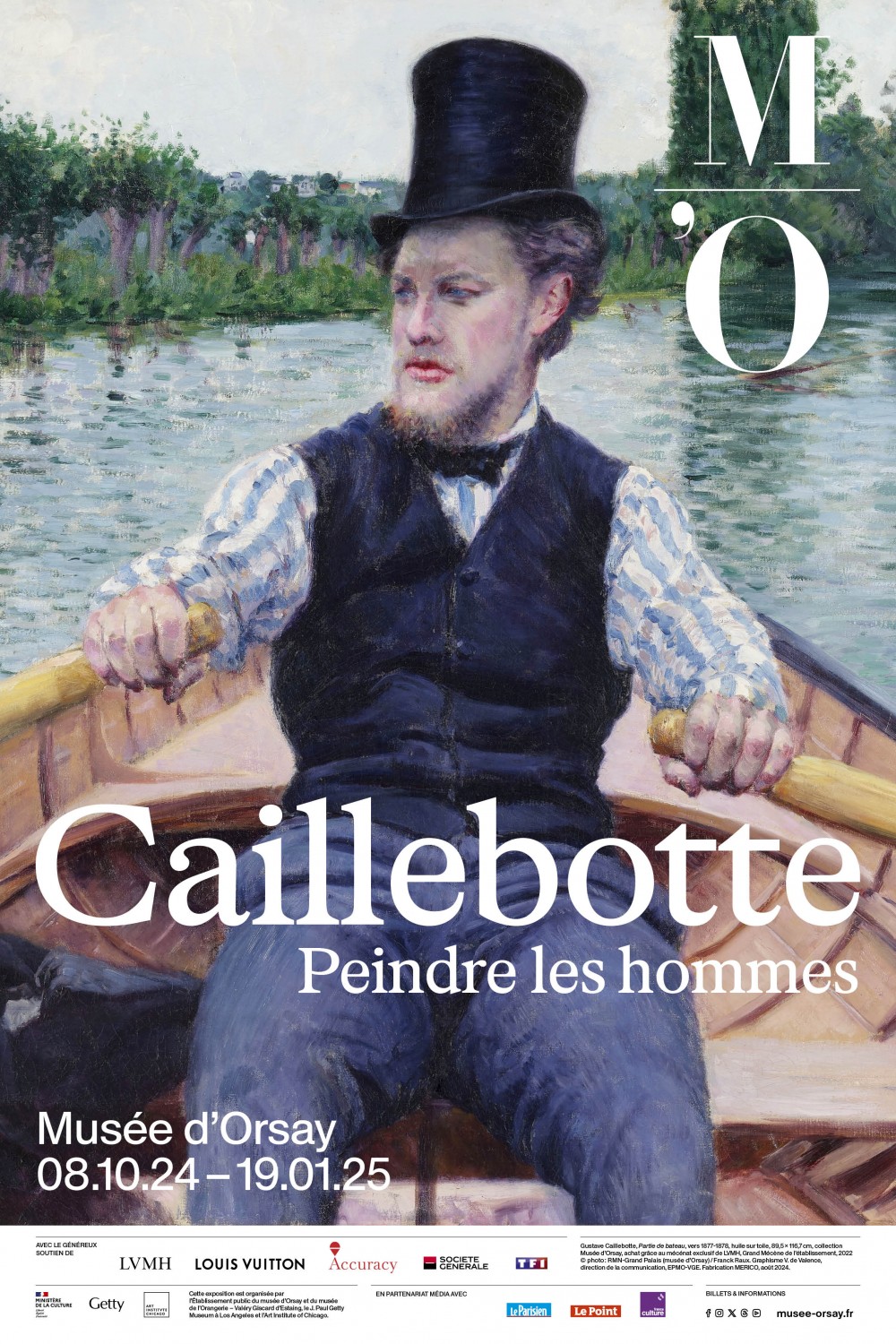
Thumbnail: poster for the exposition Caillebotte – Peindre les hommes at the Orsay museum. Source: https://www.offi.fr/expositions-musees/musee-dorsay-2897/gustave-caillebotte-peindre-les-hommes-97194.html
Organized for the 130th anniversary of Caillebotte’s death, this exposition reunited 70 of the artist’s most famous works in an attempt to rethink our impression of the way masculinity was conceived in the 19th century.
Caillebotte was an impressionist who took part in the “realism” style. He wanted to create an art that was true, that showed the world as it was. To do so, he focused on painting the urban life in Paris that surrounded him, but also the people that he shared the city with: friends, family, workers, etc. Often portraying men, Caillebotte’s works question the place of men in society, produced in a time where masculinity and republican fraternity were at the heart of peoples’ concerns.
To complement the exposition, the “impressionist” floor of the Orsay museum was reorganized to showcase the paintings that were once part of Caillebotte’s personal collection, before they were donated to the museum following the artist’s death. I particularly appreciated this “second exhibition” as it allowed me to approach Caillebotte’s relationship with art through another angle: not that of the work he produced, but of the work he chose to collect and enjoy.
Gustave Caillebotte, Etude pour Raboteurs de parquets: homme agenouillé penché vers la gauche, vers 1875, crayon sur papier, collection particulière

To draw this study, Caillebotte used a living model in order to render the posture of a worker as realistically as possible. Caillebotte, like a true academic painter, believed that drawing lots of nude studies was the best way to get a well produced final work. I especially liked this work because it shows that Caillebotte was not only an excellent painter but also a really good sketch artist. The sketch shows a side of his work we’re not used to seeing, without the impressionist
touch and the saturated colors, reduced to the simplicity of a line.
Gustave Caillebotte, Intérieur, 1880, Huile sur toile, collection particulière

What drew me to this work was the trouble that Caillebotte went through to render the textures of the fabrics in the work. Whether it be the velvety curtains, the crisp delicate lace, or the shiny tassels, all the fabrics look as though you could reach into the work to touch them. I also really like the color choice, with the deep blue and teal being so well complimented by the gold, white, and beige.
Gustave Caillebotte, Chemin Montant, 1881, Huile sur toile

Caillebotte particularly liked depicting ambiguous relationships between men and women. Seeing as the two protagonists of the work are turning their backs to us and walking closely side by side without touching, the nature of their relationship is hard to figure out. This reinforces the idea that they exist in their world which I like:
just as they are turning their back to us, hiding their identity, their relationship remains a mystery.
The specks of light passing through the leaves in the trees are particularly delicate. This gives a softness to the work, perhaps referencing the link that unites the two walkers.

Laisser un commentaire